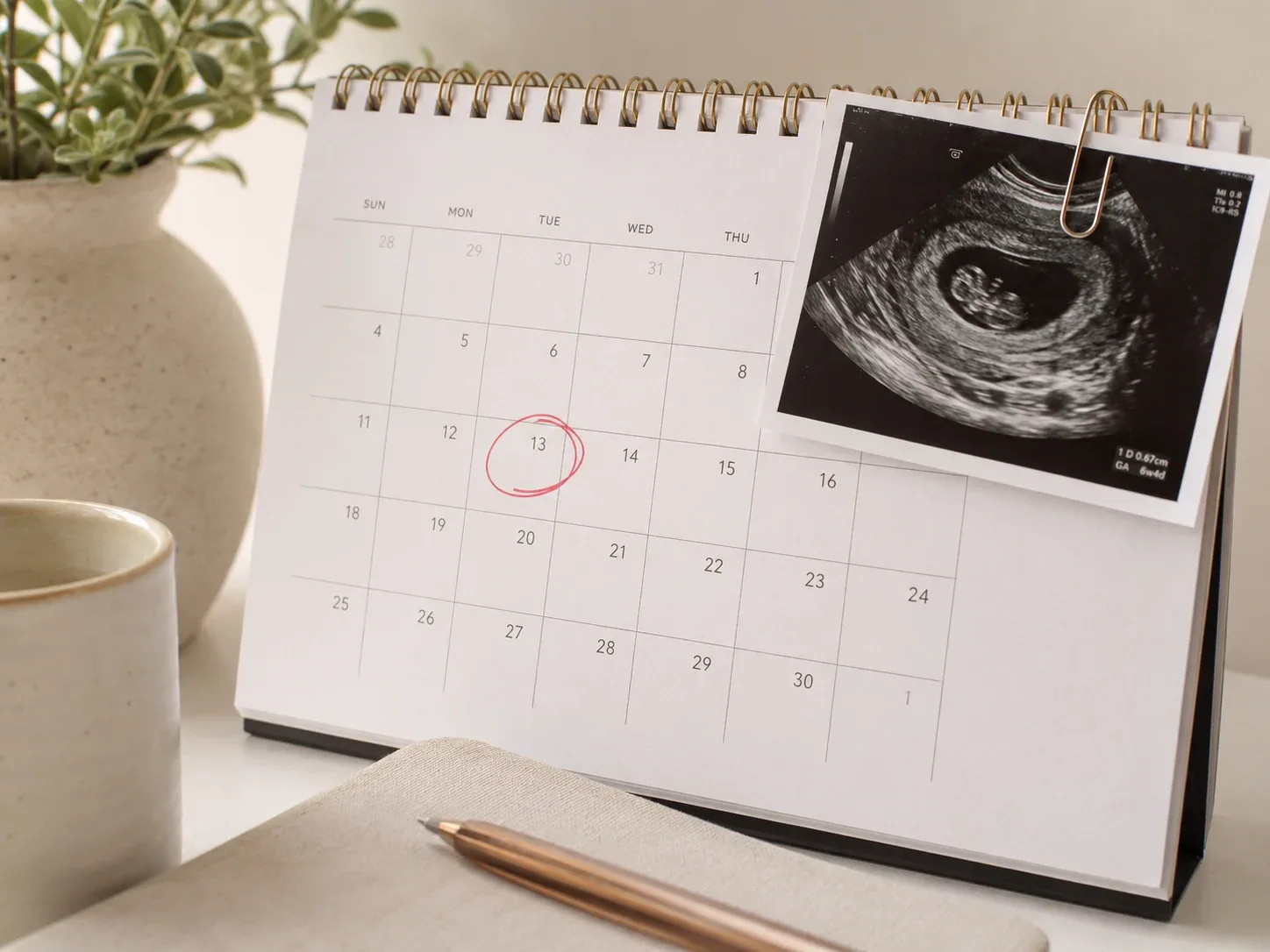
Think of a conception date predictor as a quick way to work backward through your pregnancy timeline. You plug in the first day of your last menstrual period (LMP), and the tool adds about 14 days, which is roughly when ovulation happens in a typical 28-day cycle. That gives you an estimated conception date. It won’t be exact, because ovulation timing is different for every woman. Your OB will use an early ultrasound to confirm or fine-tune your dates from there.
Jump to Section
How Does a Conception Date Predictor Work?
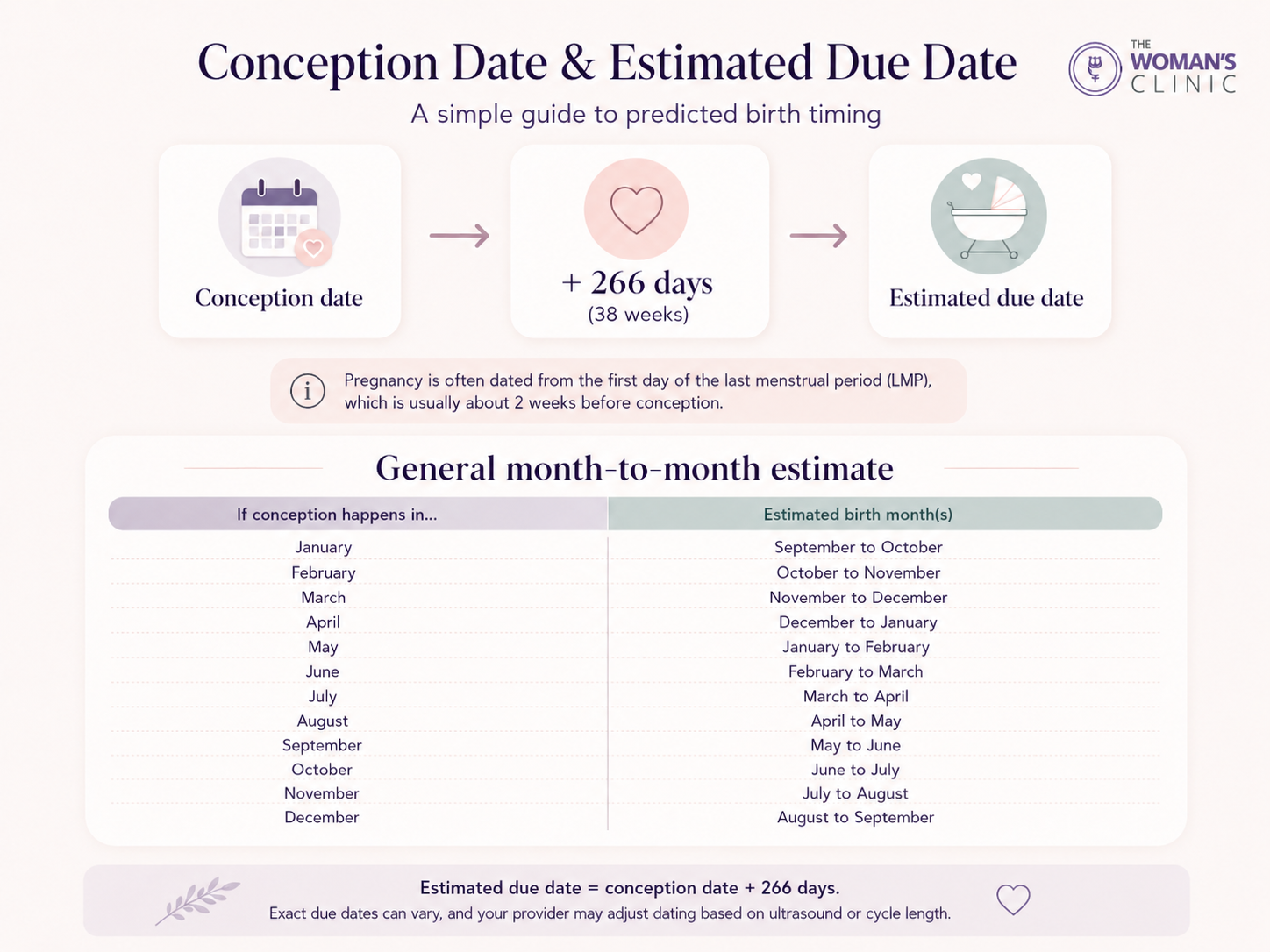
Most conception date predictors start with your last menstrual period and work outward from there. The underlying math is Naegele’s Rule, which adds 280 days to your LMP to land on a due date. From that due date, you count backward roughly two weeks to get your estimated conception date, which assumes ovulation happened around day 14 of your cycle.
That 14-day assumption is where things get complicated.
For women with a consistent 28-day cycle, it’s a reasonable estimate. For everyone else, it’s a starting point with real limitations. Sperm can live inside the body for up to five days after intercourse. The egg, though, is only viable for 12 to 24 hours after ovulation. So conception could happen the same day as ovulation or several days later, depending entirely on timing. A calculator anchored to LMP has no way to see any of that. How ovulation timing affects your conception window explains why two women with the exact same LMP can end up with meaningfully different conception dates.
The formula gives you a number. It doesn’t give you the full picture. NIH’s guidelines on estimated date of delivery confirm that LMP-based dating is the clinical starting point, and also that early ultrasound frequently adjusts the estimate from there. Your OB takes that next step.
What Information Do You Need for an Accurate Estimate?
Three things make the biggest difference: your LMP, your usual cycle length, and any tracking data you already have on hand. Each one tightens the estimate a little more.
Your LMP is where every dating method begins, even though it actually predates conception by about two weeks. Calculators, your provider’s wheel, electronic records at your OB’s office, all of them anchor to that date first. Write it down before your first appointment. You’ll be asked for it more than once.
Most calculators assume you have a 28-day cycle. You probably don’t. That gap matters more than you’d think.
Take a 35-day cycle. Ovulation isn’t happening on day 14. It’s closer to day 21, a full week later than the standard assumption. That shift changes everything about your conception estimate. Parikh’s formula corrects for this by comparing your actual cycle length to the 28-day default and adjusting the ovulation date accordingly. And because that single adjustment can move your estimated date by a week or more, it matters a lot whether your provider is using that formula or just defaulting to the standard one.
If you have an early ultrasound on file, use it. Fetal measurements in the first trimester are a more reliable dating tool than LMP alone, especially for women with irregular cycles. The math from a calculator is an educated estimate. Fetal size is a clinical measurement.
Tracking data gives you something no formula can generate on its own. If you used ovulation predictor kits or logged your basal body temperature, you have actual ovulation data rather than a statistical assumption. Tracking ovulation with predictor kits or basal body temperature narrows the conception window in a way no LMP-based calculator can replicate. NIH’s comparison of pregnancy dating methods shows that combining LMP with clinical ultrasound produces the most reliable estimates, particularly for women whose cycles don’t follow the textbook pattern.
Bring everything you have to your first appointment. Your OB will take it from there.
Why Does Your Doctor’s Date Sometimes Differ From the Calculator?
You did the math. You counted back from your last period, maybe double-checked it with a calculator, and landed on a date that felt real enough to share with your family. Then your OB mentioned something a few days off, and even though you knew it probably didn’t matter, something in you went wait, which one is right? That’s a completely normal reaction.
Here’s what’s happening behind the scenes. Providers start with your last menstrual period: it’s the earliest data point available, so it’s the working estimate until more information comes in. Your first-trimester ultrasound then either confirms that date or nudges it. Not overrides it, just refines it. When the two numbers don’t quite match, there are established clinical guidelines that determine which one takes precedence. It’s less of a conflict and more of a calibration.
The threshold is specific. If the ultrasound date differs from your LMP date by more than 7 days in the first trimester, or more than 10 days in the second trimester, the ultrasound date becomes your official clinical due date. This follows ACOG’s clinical standard for due date estimation, built on decades of research into what actually predicts gestational age most reliably.
Why does ultrasound win? The crown-rump length (CRL) measurement in the first trimester is accurate to within plus or minus 5 to 7 days. Calendar math, by contrast, assumes a perfect 28-day cycle with ovulation exactly on day 14. That’s not how most cycles work, and the error accumulates.
There’s a real clinical reason this matters. LMP-based dating has been shown to over-classify pregnancies as post-term when they aren’t, which can push providers toward interventions that aren’t actually needed. Ultrasound corrects for that.
When your OB adjusts your date, treat it as a good sign. You now have a more accurate picture of where your pregnancy is.
How Early Ultrasound Confirms Your Conception Date
When it comes to pinning down exactly how far along you are, early ultrasound is the gold standard, not because providers prefer it, but because the evidence consistently backs it up. No other method comes close in accuracy during those first few months.
Between 6 and 13 weeks, your provider gets a direct window into how the pregnancy is progressing. The main measurement they’re looking for is called the crown-rump length, or CRL, essentially the length of the embryo from head to bottom. It sounds simple, but that one small number is remarkably precise. It maps directly to a gestational age, giving your care team a reliable starting point for everything that follows.
Early in the first trimester, some providers will reach for a transvaginal ultrasound rather than the belly wand. Don’t panic. At this stage, your uterus is still nestled low in the pelvis, which means placing the probe closer to it through the vaginal canal actually produces a sharper, more accurate image than scanning from the outside would. It’s a routine call, made simply because clearer information leads to better care for you.
After about 14 weeks, dating shifts to biparietal diameter (BPD), which measures across the skull. BPD is still highly accurate. It’s just slightly less precise than early CRL, which is why providers encourage that first ultrasound before the end of the first trimester if at all possible.
What ultrasound can show you in early pregnancy goes well beyond establishing a due date. But the dating piece alone makes it worth prioritizing.
There’s one group of patients who skips all of this estimation: IVF patients. Fertilization happens within hours of egg retrieval, and the transfer date (whether day 3 or day 5) is documented exactly. The timeline is known from the start. For everyone else, early ultrasound gets as close to that level of certainty as medicine can offer.
At The Woman’s Clinic in Little Rock, early ultrasound is part of your first prenatal appointment. We do it early because an accurate date shapes every decision that follows. If you’re ready to schedule your first prenatal appointment at The Woman’s Clinic, our team is here for every step.
Why Your Conception Date Matters More Than You Think
Most women lock onto the due date and don’t think much past it. That’s completely understandable. But the due date is only as reliable as the number it’s built from.
Pregnancy is counted as 40 weeks from the first day of your last menstrual period, not from conception, which actually happens around week two. Move that starting date by even a week and every milestone shifts with it. Your screening windows, your anatomy scan, your kick count benchmarks. Everything on the calendar is anchored to that one number.
The details matter here.
First-trimester screening has narrow windows. Non-invasive prenatal testing (NIPT) is performed between 10 and 13 weeks. The nuchal translucency ultrasound, which screens for chromosomal conditions, falls between 11 and 14 weeks. Those windows aren’t flexible guidelines. If your dating is off by a meaningful amount, a test might be scheduled before it can return valid results, or after the window has closed entirely.
The anatomy scan is timing-sensitive too. Between 18 and 20 weeks, a second-trimester anatomy scan is looking at fetal structures at the exact stage when abnormalities are most visible. Go earlier and some findings simply won’t show yet. Go later and others are harder to see as the baby grows. That window exists for a reason.
Third-trimester testing follows gestational age, not the calendar. Group B Strep screening is scheduled at 35 to 37 weeks for a reason: close enough to delivery to be clinically relevant, early enough to allow for treatment if needed. That precision only works when your gestational age is accurate.
A dating error of more than a week or two doesn’t just throw off one appointment. It can quietly shift your entire prenatal schedule. You may not realize anything is off until a care decision is already in front of you.
This is why your OB doesn’t simply accept an LMP date and move forward. Your first prenatal visit includes an ultrasound specifically to confirm gestational age by measuring the embryo or fetus directly. No app, no calculator, and no best guess comes close to that level of precision.
For more on what to expect as your pregnancy unfolds, understanding your trimester milestones is a helpful place to start.
At The Woman’s Clinic in Little Rock, confirming gestational dating is one of the first things providers do. That early visit isn’t a formality. It’s how your entire prenatal schedule gets built on a foundation that actually holds.
No Embarrassing Questions, Just Real Answers
Some questions that come up in pregnancy aren’t the kind you Google at work, or ask your sister, or bring up in a waiting room full of people. We know that. This section is a place where those questions get straight answers, without any awkwardness attached. Bring whatever’s on your mind.
My cycles are irregular. Can the calculator even work for me?
Here’s the honest truth: LMP math was designed for textbook 28-day cycles, and irregular cycles simply don’t follow that script. If you ovulate on day 19 one month and day 26 the next, adding the standard 14 days to your last period can land you somewhere that has nothing to do with when you actually conceived. An early ultrasound cuts through all of that. Your OB will measure the embryo directly and establish your actual gestational age from what they see, not from what the calendar assumes.
I had sex with my partner on several days around when I think I ovulated. How does the calculator pick a date?
Here’s the honest truth: the calculator doesn’t really “pick” a day. It looks at when your last period started, estimates roughly when ovulation would have happened, and assumes conception fell somewhere in that window. But it can’t tell you which specific day, and that’s not a limitation of the tool, it’s just how biology works. Sperm can survive for several days, eggs have their own timing, and conception happens across a stretch of time, not at a single traceable moment. If you’re trying to nail down the timing for any reason, your OB can help you think through it. They’ve had this conversation more times than you’d guess, and there’s nothing to feel weird about asking.
Can the conception date help figure out paternity?
Only as a rough guide, and it isn’t reliable enough to answer that question on its own. Conception can happen anywhere within a five to six day fertile window, and calculators give you an estimate within that window, not a pinpoint date. If paternity is a medical or legal concern, DNA testing is the only definitive answer. A conception date estimate simply can’t carry that weight.
My OB moved my due date back two weeks. Does that mean I conceived later than I thought?
Most likely, yes. When the ultrasound shows your baby measuring smaller than your last period date would predict, your OB shifts the estimated due date to match what they can actually see. That shift means conception happened a bit later than the standard calendar formula assumed. Totally normal. It just means you ovulated later in your cycle than average, which plenty of women do. Nothing went wrong, and your body didn’t do anything unusual. When the calendar and the ultrasound disagree, the ultrasound is always the more reliable source, and your OB will trust it every time.
I did IVF. Is my conception date the egg retrieval date or the transfer date?
Technically, conception happened within hours of egg retrieval. That’s when fertilization occurred. Transfer follows three to five days later, once the embryo has developed to the right stage, but the biology started at retrieval. Your fertility clinic has the exact retrieval date and embryo age in your records, and your OB can use that information to calculate a due date far more precisely than the standard LMP method allows. It’s one of the clearer advantages IVF patients have when it comes to early dating.
I got a positive pregnancy test at 4 weeks. Does that mean I’ve only been pregnant for a month?
Not quite. Honestly, this trips a lot of people up. Pregnancy weeks are counted starting from the first day of your last period, so those first two weeks before ovulation are already baked into your gestational age number. At four weeks pregnant, conception most likely happened closer to two weeks ago. “Four weeks pregnant” and “pregnant for one month” sound identical, but they’re measuring different things. The 40-week clock starts before conception even happens.
I have PMOS (previously called PCOS), and my periods are unpredictable. Will the calculator give me accurate results?
Probably not. PMOS affects hormone regulation in ways that make cycles genuinely unpredictable. It is common for cycles to run 35, 60, or even 90 days, and some cycles do not result in ovulation at all. When that is the case, a calculation based on the last menstrual period is not a reliable starting point.
This is something your provider will account for. First-trimester ultrasound measurement is the standard for establishing actual gestational age in women with PMOS, and that measurement is accurate regardless of cycle history. Your OB will rely on it rather than the LMP date. Use the calculator as a rough reference, but go into your first appointment expecting the ultrasound to set the real timeline.
Can I use a conception date predictor instead of going to my doctor?
It gives you a reasonable starting point, and there’s nothing wrong with using one to get oriented while you’re setting up your first appointment. But a predictor is an estimate, and only your OB can confirm gestational age with an ultrasound. That confirmed date is what your entire prenatal schedule gets built around: your first trimester screening, your anatomy scan, every milestone that follows. Getting it locked in early means none of those windows get missed.
Pregnancy Dating Questions We Hear Often at The Woman’s Clinic
| Question | Short Answer | When to Call Us |
|---|---|---|
| How far along am I? | Counted from your last period’s first day, not conception; your OB confirms with ultrasound | At your first prenatal appointment (schedule by 8 weeks if possible) |
| What’s my due date? | Add 280 days to the first day of your last period; your OB will confirm with ultrasound | If ultrasound gives a different date, ask your OB which date to use going forward |
| Can I know my conception date without an ultrasound? | LMP-based tools give a reasonable estimate; ultrasound is the only way to confirm gestational age accurately | If LMP is uncertain or cycles are irregular, schedule sooner rather than later |
| What if my cycles aren’t regular? | Standard calculators assume 28-day cycles; irregular cycles reduce accuracy significantly | Schedule early: first-trimester ultrasound will give you a reliable date regardless of cycle history |
| When should I schedule my first prenatal appointment? | Aim for 8-10 weeks gestational age; earlier if you have irregular cycles, prior complications, or fertility history | Call (501) 664-4131 as soon as you have a positive test |
| What is crown-rump length (CRL)? | A measurement from the top of the embryo’s head to the base of the spine; used to confirm gestational age in early ultrasound | Your OB will explain the measurement and what it means at your first ultrasound visit |
Ready to Confirm Your Dates? Our OBs Are Here for You.
You now have a clear picture of how conception date predictors work, what the math can tell you, and where it runs out of road. The calculator gives you a place to start. Your OB gives you something you can actually rely on.
That first prenatal visit is where the estimate becomes a confirmed date. Your OB will perform a dating ultrasound, measure crown-rump length if you’re in the first trimester, and convert your best guess into a gestational age the rest of your prenatal care can be organized around. Every screening window, every follow-up, every milestone on your calendar flows from that number. Getting it right early is what keeps everything else on track.
If you’ve been searching for prenatal care near me in Little Rock, The Woman’s Clinic has been part of this community for more than 90 years. Our providers didn’t come here from somewhere else. They trained here, put down roots here, and built their practices caring for Central Arkansas families. There are providers on our team who have delivered the babies of women they cared for during their own pregnancies. That kind of history is rare, and we don’t take it lightly.
Our obstetrics and pregnancy care team is here for you from the moment that test turns positive, through every appointment, every question, and right up through delivery. There’s no need to wait until things feel more “official.” Coming in early lets us confirm your dates and lay the groundwork so the rest of your pregnancy can go as smoothly as possible.
The Woman’s Clinic, P.A.
9601 Baptist Health Drive, Suite 1200
Little Rock, AR 72205
(501) 664-4131
Located at Baptist Medical Towers. A free shuttle is available from the Baptist Health main campus.
Schedule your first prenatal appointment online at arobgyn.com/contact-us
When you’re ready, we’re here. Schedule a visit and let your OB put a real date on the calendar, one you can actually plan around.
